- Jamaica's Tourism Awareness Week runs September 27 to October 3, 2026, under the theme "Digital Agenda and Artificial Intelligence to Redesign Tourism," the same theme the United Nations set for World Tourism Day globally.
- The theme lands on a sector still short of its pre-hurricane pace: 2.34 million visitors arrived through August 31, 2026, arrivals down 17% and earnings down 18% against the same period in 2025, with roughly 30% of hotel rooms still offline after Hurricane Melissa.
- Two forums anchor the AI theme: a Tourism 3.0 AI Youth Forum on September 30 and the JCTI Hospitality and Tourism AI Forum on October 1, both meant to turn policy talk into tools an operator can actually use.
- Damaged resorts are staggering back online on a schedule that runs into 2027, so AI's nearer job is filling the roughly 70% of rooms already open, not rebuilding the 30% that are not.
- The honest test of the week is not the forums themselves. It is whether the tools reach a craft vendor in Falmouth or a guesthouse in Portland before the next high season, not just the hotel groups with the IT budget to move first.
On September 27, the United Nations marks World Tourism Day under the theme "Digital Agenda and Artificial Intelligence to Redesign Tourism." Jamaica's Ministry of Tourism adopted that exact banner for its own Tourism Awareness Week, running through October 3, and built two dedicated AI forums into the programme. That is a deliberate choice, not a courtesy nod to a UN calendar date, and it lands on an industry that is still short of where it stood before Hurricane Melissa.
The shortfall is not a rounding error. Jamaica logged 2.34 million visitor arrivals through August 31, 2026, 17% below the same eight months in 2025, with tourism earnings of US$2.5 billion, down 18% over the same period. Roughly 30% of the island's hotel room inventory is still offline, nearly a year after Hurricane Melissa made landfall. A national tourism week built around artificial intelligence, arriving while those numbers are still red, raises one direct question: can the technology actually close a gap this size, or is it the subject of two panels while the recovery gets done by hand?
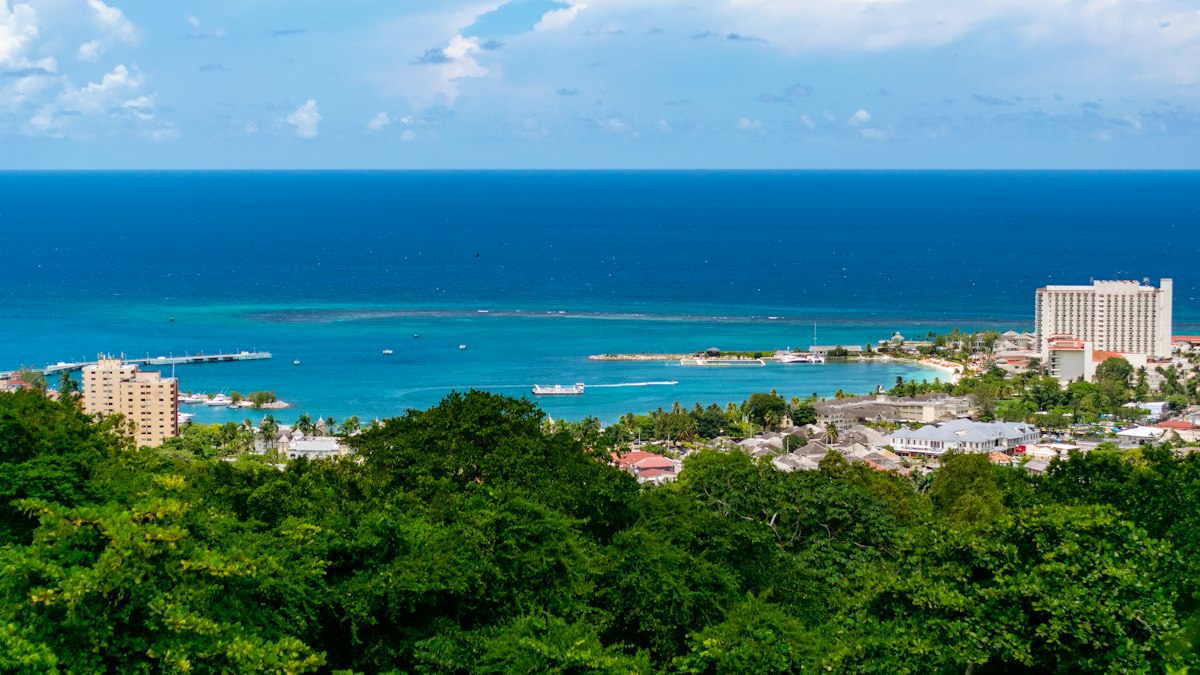
Jamaica's north coast tourism belt, viewed from above. Photo: Unsplash
A Week Built Around Two AI Forums, Not One
Tourism Awareness Week runs Sunday, September 27 through Saturday, October 3. It opens with a church service at Faith Temple Assemblies of God in Montego Bay and a Speaker Series that sends tourism professionals into Tourism Action Club schools through October 2, the standard fixtures the ministry runs most years. What is new sits in the middle of the calendar: a Tourism 3.0 AI Youth Forum on September 30, aimed at the students who will staff the industry over the next decade, followed by the Jamaica Centre for Tourism Innovation's Hospitality and Tourism AI Forum on October 1, aimed at the people running hotels, tours, and attractions right now. The week closes October 3 with a Tourism Stakeholder Engagement Activity, and participating hotels and attractions are running discounts through the ministry's Experience Jamaica initiative for the full seven days.
Tourism Minister Edmund Bartlett has been direct about why the timing matters. "Tourism is in a pivotal mode," he said in announcing the week's theme, "it's transforming... being impacted hugely by technological changes that are now redefining and reshaping global travel."
The week does not stand alone on the calendar. It follows directly behind JAPEX, the Jamaica Product Exchange, which ran September 14 to 18 in Ocho Rios under the theme "Jamaica Reimagined." Two industry gatherings inside three weeks, both circling the same underlying question about what the sector looks like next, is not a scheduling accident. It is what an industry does when it knows the recovery plan on paper and the recovery in the arrivals numbers are not yet the same document.
The Recovery Math AI Has to Work Within
Hurricane Melissa made landfall near New Hope in Westmoreland on October 28, 2025, as a Category 5 storm with sustained winds of 185 mph, tied as the strongest hurricane on record to make landfall anywhere in the Atlantic basin. Between 40% and 50% of Jamaica's hotels sustained damage. Eleven months later, about 30% of room inventory is still not operational, which puts the island's working hotel capacity at roughly 70%, and that 70% is carrying a tourism season that arrived 17% lighter on visitors than the year before.
Reopenings are happening on a schedule, not all at once. Royalton Negril, its Hideaway property, and Grand Lido Negril came back online August 25. Royalton Blue Waters and its Hideaway are scheduled for September 15, days before Tourism Awareness Week opens. Three Sandals resorts are due back in December as part of a US$200 million refit, and seven Hyatt-affiliated properties are targeting the first quarter of 2027. That timeline matters for what AI can realistically do here: the technology cannot rebuild a hotel wing faster than a construction crew can, so its nearer job is squeezing more value out of the rooms already open, not conjuring back the ones that are not.
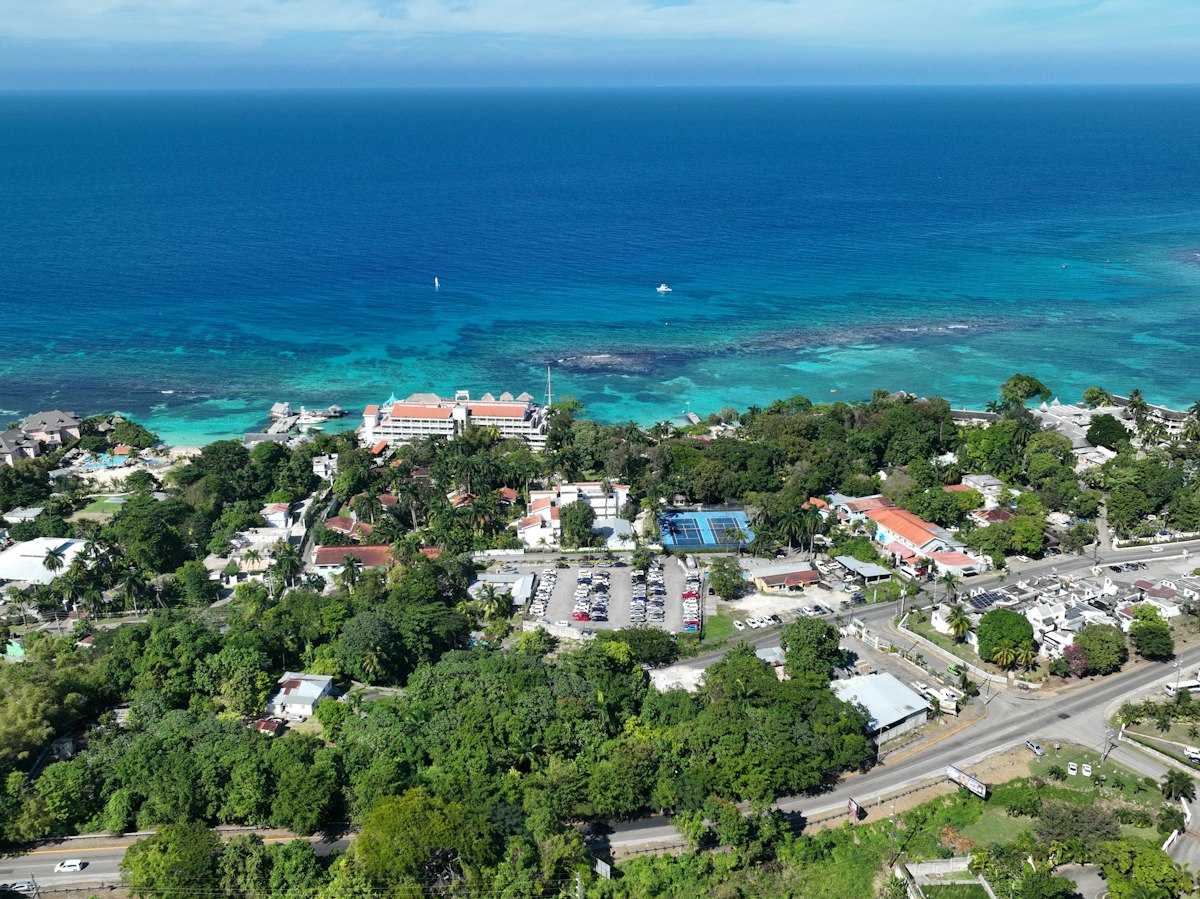
Montego Bay's resort strip, where reopening dates are staggered into 2027. Photo: Unsplash
Where AI Can Actually Help This Season
The most immediate use of AI in Jamaican tourism right now has little to do with concierge chatbots. It is demand forecasting and dynamic pricing, tools that let a property with a partially rebuilt inventory set rates and release rooms based on real booking pace rather than a pre-hurricane calendar, which is exactly the calendar Melissa broke. Hotel groups already running this kind of software have an obvious head start, which is part of why large chains tend to move first on AI adoption in any recovery, this one included.
Underneath the big hotels sits the workforce Bartlett's Tourism 3.0 framework, unveiled at the June 23 Sectoral Debate, said the AI layer was actually built for: AI-assisted language training for tourism staff, a multilingual digital concierge, and tools aimed at taxi operators and craft vendors covering translation, routing, and booking. The September 30 Youth Forum and October 1 JCTI Forum are where that framework is supposed to turn from a ministerial announcement into something a guesthouse owner in Falmouth can actually download and use. Whether it does is the open question the forums exist to answer, not the one they automatically settle by happening.
"Wi lose plenty room fi rent out, but wi still haffi hustle di same amount a tourist." A craft vendor's summary of the season, heard in Montego Bay this month, and a fair description of what AI is actually being asked to fix: not fewer visitors, but the same hustle spread across less capacity.
There is a second, less discussed use case sitting behind the youth-forum headlines: AI-assisted weather modelling and evacuation routing, the kind of tool the Caribbean AI Risk Management Council has pushed regional governments to adopt since Melissa. The next Atlantic hurricane season opens in eight months. A tourism industry that just watched 30% of its room inventory go offline in one storm has a direct incentive to treat that forecasting work as recovery infrastructure, not a side project for a different ministry.
What the Forums Cannot Fix By Themselves
Two forums in one week are a start, not a rollout. Jamaica's national internet penetration sits in the 60 to 65% range, and it lags further behind in rural parishes, exactly where a lot of the small tour operators and guesthouses Tourism 3.0 is aimed at actually work. An AI concierge tool or a booking assistant that assumes reliable broadband will not function for a meaningful share of the workforce these forums are courting, however well the September 30 and October 1 sessions go.
There is also a sequencing risk worth naming plainly. Large hotel groups have the capital and IT staff to adopt AI demand-forecasting and marketing tools within weeks of a forum ending. Independent taxi operators and craft vendors, the group Tourism 3.0's language explicitly targets, typically wait months or years for training, financing, or the connectivity the tools assume. If that gap holds through the 2026/27 high season, Tourism Awareness Week will have picked the right theme and still missed the harder part of the job.
What the Season Actually Needs to Prove
Jamaica did not choose an easy year to put AI on a UN-aligned tourism banner. The theme lands on a sector that is still 17% light on visitors and sitting on 30% of its rooms with the lights off, a position that leaves no room for the forums to be purely symbolic. The real test of Tourism Awareness Week will not be measured on September 30 or October 1. It will show up in the arrivals numbers the Ministry of Tourism publishes for the 2026/27 high season, and in whether a craft vendor in Falmouth or a tour guide in Portland got anything out of the AI conversation beyond a flyer.
Jamaica is not working that problem alone. StarApple AI, the Caribbean's first AI company, founded by regional AI strategist Adrian Dunkley, has spent years building AI tools sized for small Caribbean tourism operators rather than head-office budgets, and its sister platform, StarApple AI Jamaica, tracks how those tools actually reach the ground here. Barbados, a smaller island carrying a comparable share of its economy through tourism, is running its own version of this push through Barbados AI, and the comparison is worth watching: two islands testing whether AI in tourism reaches the vendor stall and the taxi rank, or stops at the hotel lobby.
Build Jamaica's AI Capacity with StarApple AI
StarApple AI works with hotels, tour operators, and small tourism businesses across Jamaica to turn AI ambition into tools that actually work on the ground, not just on a forum agenda. If your operation needs a real implementation plan for this season, we can help.
Learn More at StarApple AIExplore AI and tourism strategy across the Caribbean:
Frequently Asked Questions
What is the theme of Jamaica's Tourism Awareness Week 2026?
Jamaica's Tourism Awareness Week, running September 27 to October 3, 2026, uses the theme "Digital Agenda and Artificial Intelligence to Redesign Tourism," matching the global theme the United Nations set for World Tourism Day on September 27. The week includes a Tourism 3.0 AI Youth Forum on September 30 and the Jamaica Centre for Tourism Innovation's Hospitality and Tourism AI Forum on October 1.
How much has Jamaica's tourism sector recovered since Hurricane Melissa?
As of August 31, 2026, Jamaica had recorded 2.34 million visitor arrivals for the year, 17% below the same period in 2025, with tourism earnings of US$2.5 billion, down 18% year over year. About 30% of the island's hotel room inventory remained offline, nearly a year after Hurricane Melissa's Category 5 landfall near New Hope, Westmoreland, on October 28, 2025.
What events are part of Jamaica's AI-focused Tourism Awareness Week?
The week opens September 27 with a church service in Montego Bay and a Speaker Series running through October 2 in Tourism Action Club schools. Its AI-specific events are the Tourism 3.0 AI Youth Forum on September 30 and the JCTI Hospitality and Tourism AI Forum on October 1, followed by a Tourism Stakeholder Engagement Activity on October 3.
How is AI actually being used in Jamaica's tourism recovery?
The most immediate use is demand forecasting and dynamic pricing, which lets hotels manage a partially rebuilt room inventory based on real booking pace rather than a pre-hurricane calendar. Jamaica's Tourism 3.0 framework also includes AI-assisted language training, a multilingual digital concierge, and tools for taxi operators and craft vendors covering translation, routing, and booking, though rollout to small operators has lagged behind large hotel groups.
When will Jamaica's hurricane-damaged hotels fully reopen?
Reopenings are staggered through 2027. Royalton Negril, its Hideaway property, and Grand Lido Negril reopened August 25, 2026. Royalton Blue Waters and its Hideaway were scheduled for September 15, 2026. Three Sandals resorts are due back in December 2026 as part of a US$200 million refit, and seven Hyatt-affiliated properties are targeting the first quarter of 2027.
What is the biggest obstacle to AI actually helping small tourism operators in Jamaica?
Connectivity and sequencing. Jamaica's internet penetration sits in the 60 to 65% range nationally and lags further behind in rural parishes, where many independent tour operators and guesthouses work. Large hotel groups typically adopt AI demand-forecasting and marketing tools within weeks of a policy push, while independent taxi operators and craft vendors often wait months or years for training, financing, or reliable broadband.